
The world is full of colors—from the bright reds of a sunset to the deep greens of a forest. Colors affect how we see and experience everything. But for millions of people, colors can look different or may not be visible at all. This condition is called color blindness, and it’s often misunderstood.
Let’s take a closer look at what it really means to see the world without all the colors.

Source: https://piximus.net/others/how-people-with-different-types-of-color-blindness-see-the-world
More Than Just “Seeing in Black and White”
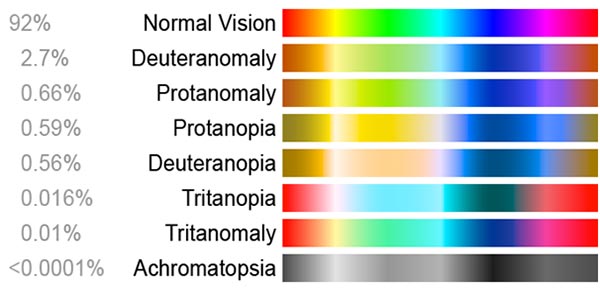
A common mistake about color blindness is thinking that everyone with it sees the world in black and white. While there is a rare condition called achromatopsia, where people can’t see any color, most people with color blindness can still see colors but have trouble telling some apart.
The most common types of color blindness are:
- Trouble telling blue from yellow
- Trouble telling red from green
Within the red-green types, there are a few variations:
- Deuteranomaly: Green looks less bright.
- Protanomaly: Red looks less bright.
- Deuteranopia: No green perception at all.
- Protanopia: No red perception at all.
There are also types where people can’t tell blue from yellow, called Tritanopia, but these are less common.

Source: https://www.lenstore.co.uk/eyecare/sites/default/files/inline-images/colour-blind-chart.jpg
What Causes Color Blindness?
Color blindness happens because of problems with cone cells in the retina, which are needed for seeing colors. These cells have pigments that are sensitive to different light wavelengths, like red, green, and blue. When one or more of these cone cells are missing, damaged, or not working properly, color blindness usually occurs.
Most of the time, color blindness is passed down from parents through genes. Since the genes for red and green color vision are on the X chromosome, it’s more common in men. Women have two X chromosomes, so if one is faulty, the other can often fix the problem. But since men only have one X chromosome, if they inherit the faulty gene, they will have color blindness.
In rarer cases, color blindness can develop later in life due to eye problems, injuries, certain medications, or getting older.

A Different Way of Seeing, Not a Lesser One
Understanding color blindness means realizing that it’s just a different way of seeing the world. It doesn’t stop people from appreciating the beauty around them, even if it’s more challenging at times. No matter how someone sees colors, we can make the world more inclusive and accessible by raising awareness and making small changes.
References
American Academy of Ophthalmology. (2024, September 10). What is color blindness? Retrieved from https://www.aao.org/eye-health/diseases/what-is-color-blindness
Color Blind Pal. (n.d.). Color Blind Pal. [Mobile application]. Retrieved from https://apps.apple.com/us/app/color-blind-pal/id1037744228 or https://play.google.com/store/apps/details?id=com.colorblindpal.colorblindpal
EnChroma. (n.d.). EnChroma® Color Blind Glasses | Color Blind Eyewear. Retrieved from https://enchroma.com/
Medline Plus (n.d) Achromatopsia Retrieved from: https://medlineplus.gov/genetics/condition/achromatopsia/#:~:text=Description&text=Achromatopsia%20is%20a%20condition%20characterized,such%20as%20red%20and%20green.
MedlinePlus. (2015, January 1). Achromatopsia – Genetics. Retrieved from https://medlineplus.gov/genetics/condition/achromatopsia/